The Listening Rooms of Osu
Small venues are rebuilding the city's live-music habit, one Sunday at a time.
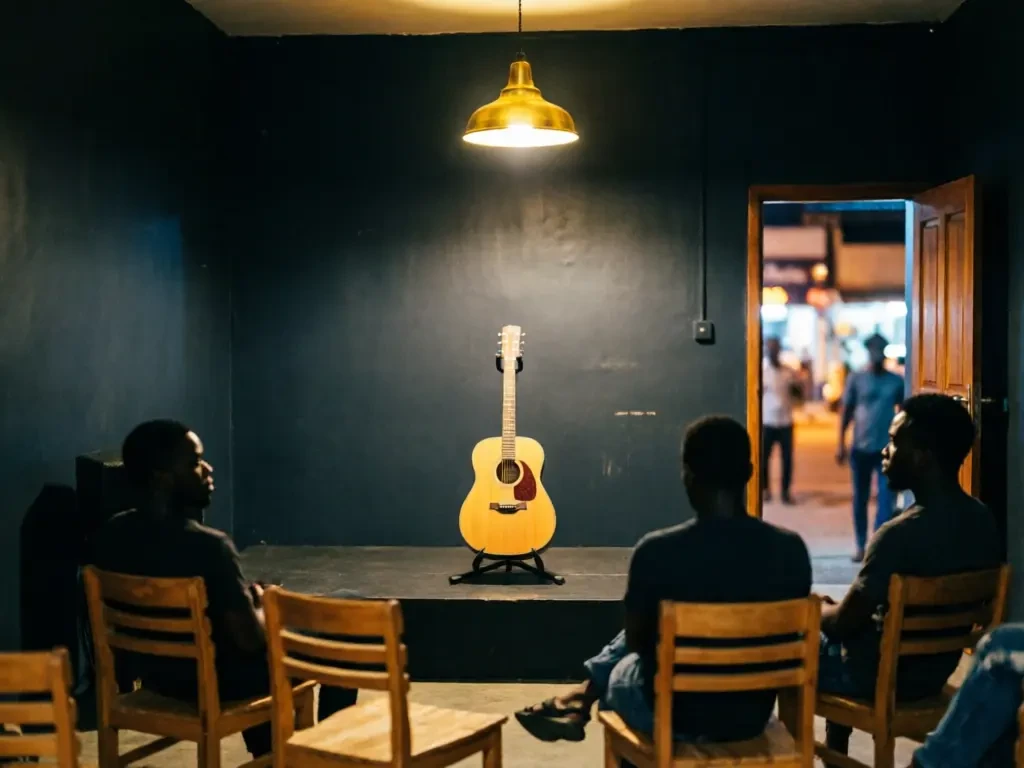
The room holds about forty people if nobody stands near the door. There is a stage the size of a large table, one lamp, and a rule printed on a card at the entrance: talk in the corridor. The first set starts at seven, which means it starts at ten past seven, which everyone in the room has planned for.
Accra has never lacked for places to hear music. It has lacked places to listen to it. The distinction sounds precious until you sit in a room where it is enforced, and realise how rarely you have heard a guitar without a conversation layered over it.
Why small rooms came back
The venues that opened in the last three years are not trying to compete with the large weekend nights. They run on weekdays, they seat people, they finish early enough that the audience can still get home. Several are attached to restaurants and would not survive without them. The music is not the business model. It is the reason the room has a character.
That arrangement has a cost. A seated room sells fewer drinks than a standing one, and a seven o'clock start means the bar has two good hours rather than five. The venues that are working have solved this by making the evening a whole thing: dinner, then the set, then a short second set and out by ten.
We are not selling tickets. We are selling an hour where nobody is allowed to talk over the music.
The musicians' side
For performers, a listening room changes the job. A set designed for a loud room is built on volume and momentum. A set designed for forty seated people has to survive attention, which is harder. Several musicians now play the same material twice in a month: once for a large crowd, once for a small room, and they are not the same arrangements.
The pay is modest and the exposure is limited. What the rooms offer instead is rehearsal in front of an audience that is actually listening, which is the only way a new arrangement gets better.
By nine the room is emptying, the lamp is off, and the chairs are stacked against the wall. The next set is in six days. It will start at ten past seven.
Filed under
About the author
Selorm Attah
Music and nightlife writer
Selorm has been reviewing small rooms and loud rooms in Accra since 2019, always with a notebook and never with a guest list.