Kente in the Age of the Feed
Weavers in Bonwire are renegotiating pattern, price and pace with an audience they will never meet.
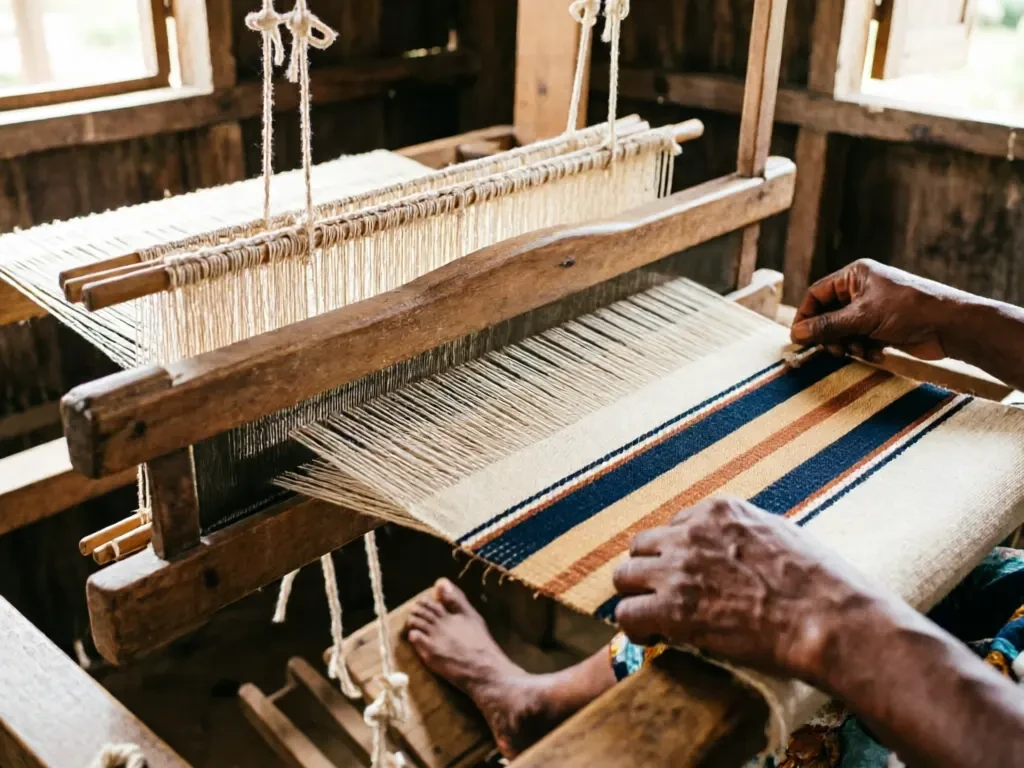
The loom takes up most of the room. It is wooden, older than the man working it, and it produces cloth in strips about ten centimetres wide that will later be sewn edge to edge into something much larger. The whole logic of kente is in that delay: you weave a narrow thing for weeks and only at the end do you see the pattern the strips make together.
That logic sits awkwardly beside the way cloth is now bought. A photograph on a screen is instant, complete, and detached from the eleven weeks it took to make. The weavers in Bonwire are not resisting this. They are trying to work out what to charge for it.
The pattern is an argument
Every established pattern has a name, and most names carry a meaning that was decided long before the weaver was born. Some refer to a proverb. Some to a historical event. Some to a quality the wearer is claiming for themselves. Choosing a cloth is therefore not a purely visual decision, and weavers will tell you so, politely, before they tell you the price.
What is new is the request for custom patterns: a company wanting its colours, a family wanting a design for a specific occasion, a young buyer asking for a strip that photographs well. These are reasonable requests. They also take time to develop, and time is the one thing the market does not price well.
People ask how long it takes and then they are surprised by the answer. The loom is not slow. The loom is honest.
The pace problem
A single strip of a complex pattern can take a full day. A full cloth can take a month of working days, sometimes two. Set against that, the price of an imported printed fabric in a market is not a comparable number at all, and yet it is the number buyers arrive with.
Several workshops have responded by splitting their output. Simpler patterns in familiar colours go to the market stalls at a price that can compete. Complex work is commissioned, priced individually, and increasingly sold directly to buyers abroad who understand what they are ordering.
What the feed changes
The direct route has changed the workshop's relationship with its customers. Orders now arrive by message, often with a screenshot and a question about whether a colour can be changed. Weavers describe this as both an opportunity and an interruption: the work is better paid, but it is constantly being asked to justify itself in a format designed for something else.
The younger weavers are less troubled by this. They photograph their own work, explain the pattern names in captions, and treat the loom as something worth showing rather than something to be protected from view. One of them described the workshop to me as a place with two doors: one onto the road, one onto the world.
Both doors were open the afternoon I visited. Inside, the loom kept its own pace, indifferent to either.
Filed under
About the author
Efua Quaye
Culture editor
Efua writes on craft, music and inheritance. She grew up between Accra and Koforidua and keeps a running list of workshops worth visiting.