Accra After the Waterfront
A decade of new civic buildings has changed how the city faces the sea, and how it argues with itself.
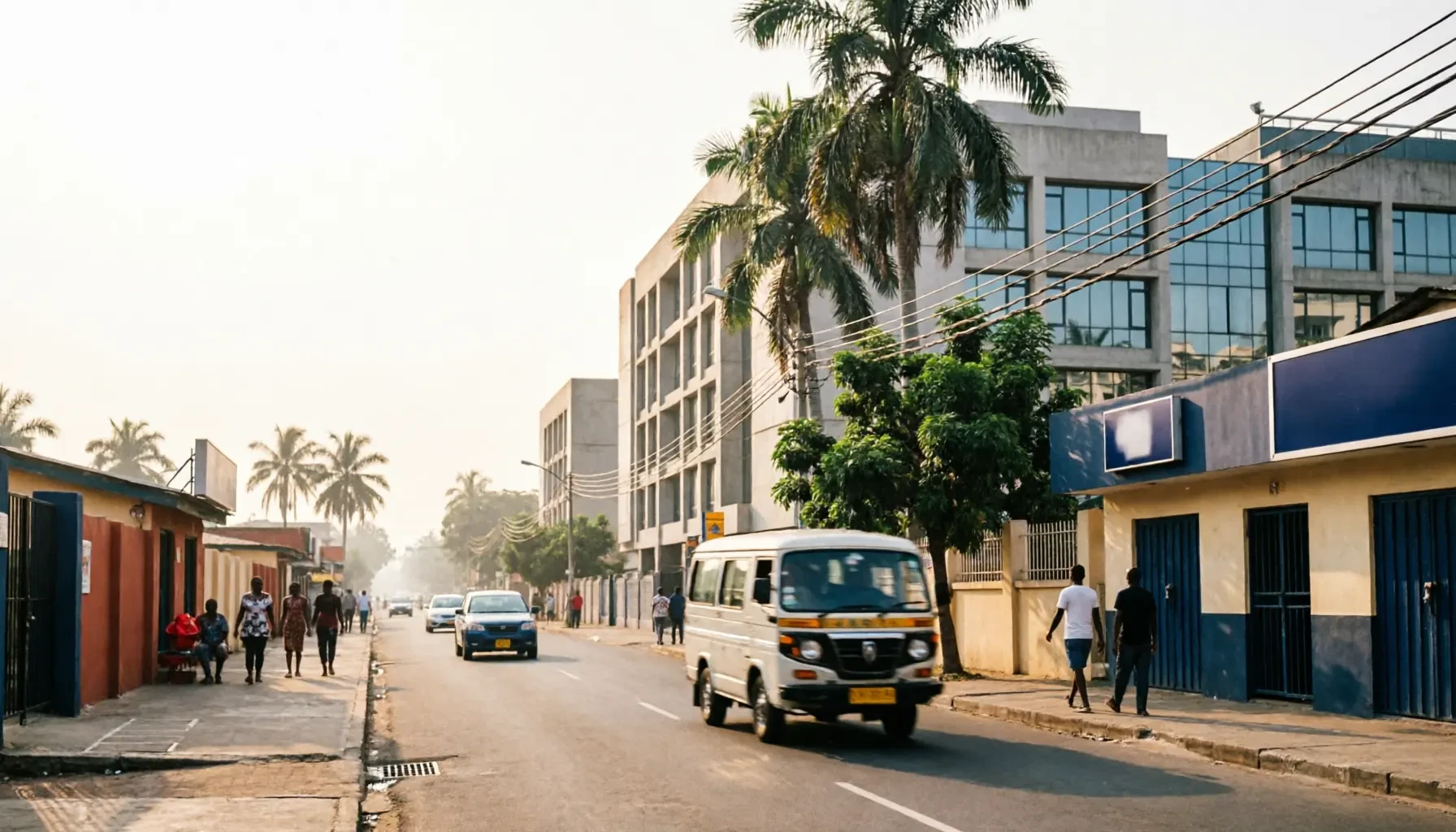
There is a stretch of road between the old harbour and the ministries where the city seems to hold its breath. On one side sit the low warehouses that once handled cocoa and timber, their loading bays still opening onto the street. On the other, a row of buildings finished within the last ten years: pale stone, deep window reveals, glass that turns the sky back on itself. Drive it at eight in the morning and the contrast is almost too neat, as though someone had drawn a line and asked the city to choose a side.
For most of its modern life, Accra turned away from the sea. The shoreline was working infrastructure, not a place to stand and look. That has changed faster than most people expected, and the change has been argued almost entirely through buildings rather than through any published plan.
The new edge
Walk the waterfront on a weekday and you notice the thresholds first. Older buildings meet the pavement with a step and a locked gate. The newer ones meet it with a colonnade, a low wall you can sit on, a strip of planting that behaves like an invitation. Architects call this the public edge, the first metre of a building where the city is either welcomed or kept out.
The shift did not come from a single client. It came from a generation of practices that began, around 2015, to treat shading as structure rather than decoration. Deep reveals, perforated screens, verandas pulled out far enough to hold a meeting: these are not flourishes. In a city that is hot for most of the year, they are the difference between a building people use and a building people pass through.
We spent forty years building our backs to the water. The interesting question is not whether we turned around. It is what we think we are looking at now.
What the buildings argue
Civic buildings are unusually honest about what a city believes. A ministry that faces a road with a fence is telling you the road is a problem. A ministry that faces the same road with a shaded entrance and a public forecourt is telling you something else entirely, and it is worth noticing which of the two Accra has been building.
The last decade has produced both. The most convincing projects are not the largest. They are the ones where the architects spent their budget on the ground floor rather than the roof: a deep overhang, a bench, a step wide enough for two people to pass while a third stops to talk. Those decisions are cheap. They are also the ones that survive a change of management.
What has not been resolved is the space between buildings. A row of well-made facades does not make a street. The waterfront still has stretches where the pavement disappears for thirty metres, where a wall turns its back, where the only way to continue walking is to step into traffic and hope.
The unfinished argument
The next argument will be about continuity. Accra has enough individual buildings to make the case for a certain kind of city. It does not yet have the continuous, walkable, shaded edge that would make that case convincing at street level.
This is a slower kind of work. It involves agreements between neighbours about where a wall sits, how a gate opens, whether a shopfront can extend three metres into the pavement without closing it. It is less photogenic than a new civic hall and considerably more important.
Still, the direction is legible. Ten years ago the waterfront was a place you avoided unless you worked there. Now people walk it on a Sunday, slowly, the way people walk a promenade in a city that has decided the sea belongs to everyone. That decision was made by buildings, one threshold at a time.
Filed under
About the author
Ama Boateng
Contributing editor, design
Ama writes about architecture and public space in West Africa. She has spent the last six years documenting how Accra builds at its edges.