How Accra Learned to Walk Again
Sidewalks, shade trees and the quiet politics of a fifteen-minute errand.
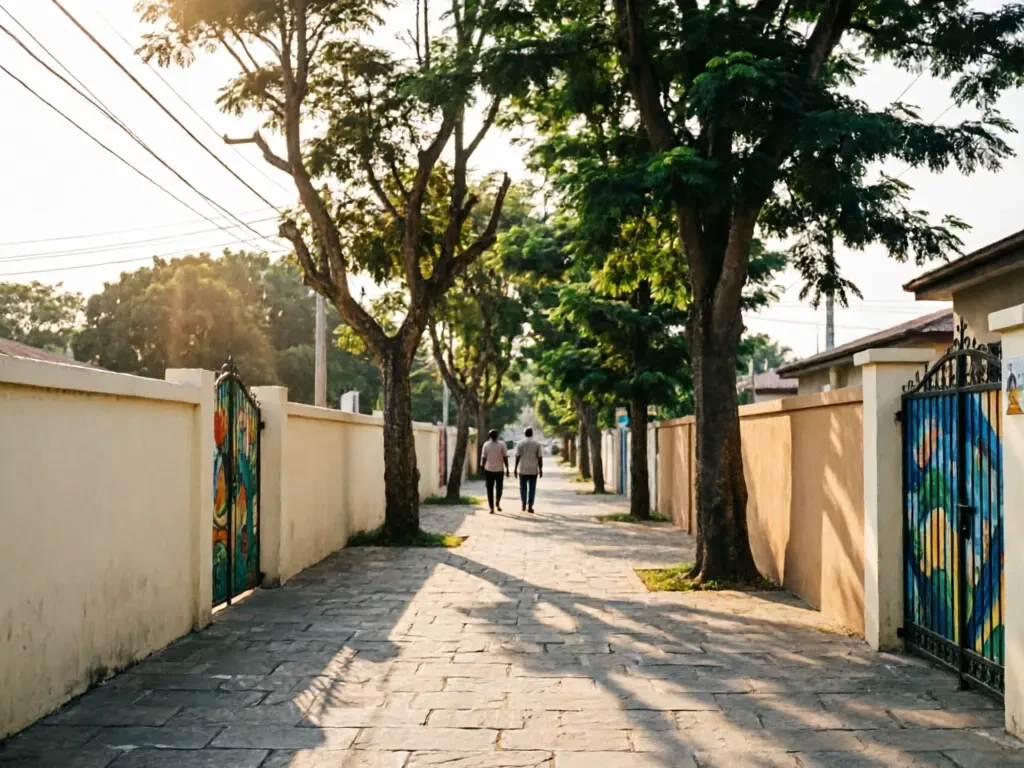
The errand is the smallest unit of city life and the hardest to plan for. Fifteen minutes on foot to a pharmacy, a phone credit kiosk, a school gate: if that walk is unpleasant, a household will make the same trip by car, and the street will carry one more vehicle for the rest of the day.
This is the argument behind most of the pavement work happening now, and it is a much less glamorous argument than it sounds. Nobody commissions a photograph of a kerb. But the kerb is where the decision is made.
Three things a pavement needs
Ask people who walk regularly what makes a route usable and the answers are consistent. Width, so two people can pass and a third can stop. Continuity, so the pavement does not disappear at a junction and reappear forty metres later. And shade, which in this city is not a comfort but a condition of use.
- Width: enough for two people to pass without stepping into the road.
- Continuity: no gap that forces a pedestrian into traffic.
- Shade: mature trees or a canopy, not a painted line.
- Surface: level enough for a handcart, a wheelchair, a school bag on wheels.
The shade point is the one most often skipped. A newly paved street with no trees is usable at seven in the morning and abandoned at one in the afternoon. Trees take years to work, which means the decision has to be made before the pavement is finished, not after.
The politics of the kerb
A widened pavement removes something: a parking bay, a stall, a place where a shop displays its stock. Those are real losses for real people, and they are the reason pavement projects get contested street by street rather than celebrated as a programme.
Nobody objects to a pavement in principle. They object to the metre it takes from their frontage. So you have to show them the metre it gives back.
The projects that have held up are the ones that negotiated that trade openly: a stall relocated rather than removed, a loading bay kept but narrowed, a tree planted where the shade falls on the queue rather than on the wall.
What changes when people walk
The measurable effects are modest and slow. A street with a working pavement gets more small trade at its edges, because a person on foot can stop. It gets fewer short car trips. It gets, more than anything, a different kind of attention: people who walk a route know it in a way that drivers do not.
That knowledge is the point. A city that can be walked is a city whose problems are visible to the people who could fix them. The pavement is where that starts, one metre at a time.
Filed under
About the author
Kojo Anaman
Urbanism contributor
Kojo works on transport and street design, and walks most of the routes he writes about.